The acromioclavicular joint, commonly called the AC joint, is the small joint at the top of the shoulder where the collarbone meets the shoulder blade. It is supported by strong ligaments that help keep the collarbone stable and correctly aligned with the shoulder. An AC joint injury, often referred to as a shoulder ‘separation’, can occur after a fall, direct blow to the shoulder, sporting injury or accident. In more severe injuries, the supporting ligaments may be torn, causing pain, swelling, visible prominence of the collarbone, weakness and difficulty lifting or using the arm. Many AC joint injuries can be managed without surgery. AC joint reconstruction is considered when there is a high grade (usually grade 3 or above) or when shoulder function continues to be affected despite appropriate non-surgical treatment.
AC joint reconstruction is a surgical procedure used to restore alignment and stability to the AC joint. The aim of surgery is to stabilise the collarbone by supporting healing of torn ligaments or performing a reconstruction of these ligaments when needed.
The acromioclavicular (AC) joint is the small joint at the top of the shoulder where the collarbone (clavicle) meets the highest point of the shoulder blade (acromion). Strong ligaments support this joint and help keep the collarbone stable and aligned during shoulder movement.
An AC joint injury, commonly known as a shoulder separation, occurs when these supporting ligaments are stretched or torn. It most often follows a direct impact to the top of the shoulder, such as:
Lower-grade AC joint injuries are generally treated without surgery, while some higher-grade injuries may be considered for early surgical stabilisation. Surgery may also be considered for a chronic (longer standing) AC joint injury when pain, instability or altered shoulder function continues after several months of appropriate non-surgical treatment. Chronic injuries may require reconstruction of the damaged ligaments because their ability to heal naturally reduces over time.
The decision to proceed with AC joint reconstruction depends on the injury pattern, degree of displacement, duration of symptoms, shoulder function and individual work or sporting requirements.
Imaging:
AC joint reconstruction is performed under general anaesthesia. The procedure is performed using an open or arthroscopically assisted technique. The approach depends on the type and age of the injury, the degree of instability and whether other shoulder structures also require treatment.
During surgery, Dr Richard Dallalana restores the collarbone to its normal alignment with the shoulder blade. The damaged coracoclavicular ligaments, which connect the collarbone to a part of the shoulder blade called the coracoid, will then go on to heal. In long standing injuries (>6 weeks), a graft is used to reconstruct the ligaments, and this is taken from a nearby place in the shoulder (Weaver-Dunn transfer) or in some cases or reconstructed using a donated ligament graft such as a hamstring tendon.
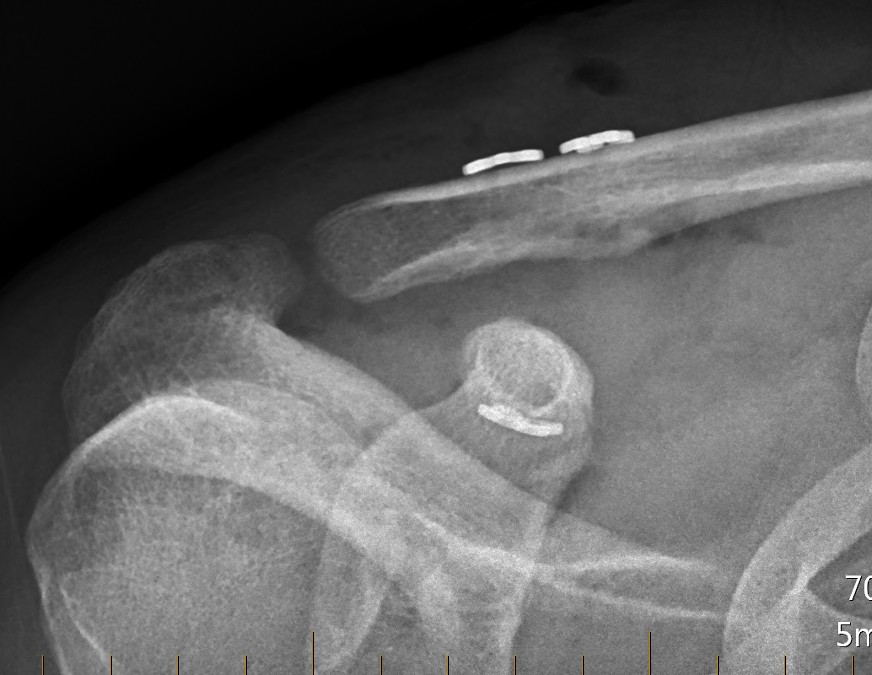
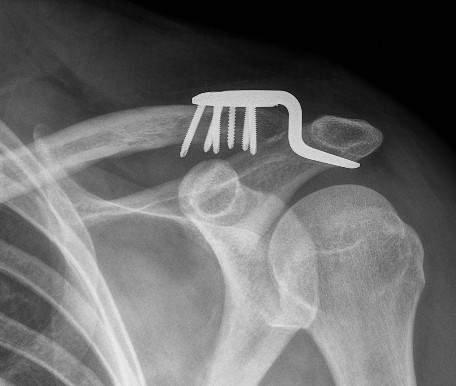
Ligament reconstruction is needed, using either:
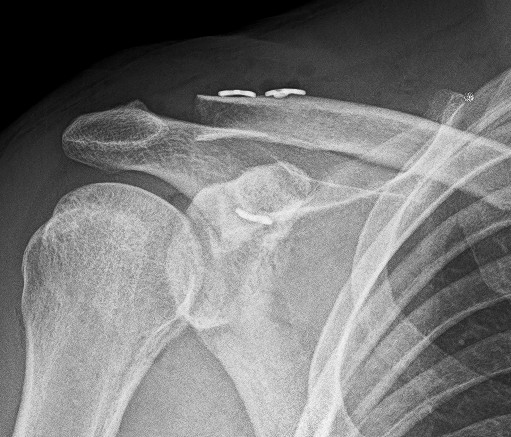
Reconstruction aims to improve both vertical and horizontal stability of the AC joint. Once the joint is stable and correctly aligned, the incisions are closed and covered with dressings. The arm is placed in a sling to protect the reconstruction during the early healing period. The exact reconstruction technique is tailored to the individual injury and surgical findings.
A post-operative review will be arranged to assess wound healing, check the position and stability of the reconstruction and guide the next stage of rehabilitation. This is normally around 2 weeks from surgery.
During the first stage, the shoulder is protected in a sling while the reconstruction begins to heal. This is usually 4 weeks. Gentle movement of the fingers, wrist and elbow is encouraged, together with any shoulder blade or limited shoulder exercises prescribed by the physiotherapist who attended during the hospital stay.
The sling may be removed at night, whilst eating and performing other simple tasks and for desk based work.
Shoulder movement is increased progressively. Early exercises may be limited to a specific range, increasing to regain full range by the end of this period. Sudden movements and lifting should be avoided.
Physiotherapist guidance is preferred from this stage onward.
Light strengthening exercises may begin. Rehabilitation commonly focuses on the rotator cuff and shoulder blade muscles.
Theraband initially progressing to light weights.
Everyday tasks, work duties, gym exercises and recreational activities are reintroduced as movement, strength and shoulder control improve. Heavy lifting, pressing movements, contact sports and repetitive overhead use are delayed until the reconstruction has healed adequately, usually around 4 months.
Heavy gym exercises, pressing movements, contact sport and activities with a risk of falling onto the shoulder should be avoided until the reconstruction has healed and adequate movement, strength and control have returned.
A return to contact sport will take a minimum of 4 months, if adequate strength and shoulder function has returned.
Dr Richard Dallalana and your physiotherapist will provide individual guidance based on the reconstruction performed, your progress and the demands of your work or sport.
As with any operation, there are potential risks and outcomes vary between patients.
Some loss of the surgical correction is the most commonly reported complication after AC joint repair or reconstruction. However, a change in the appearance or position of the collarbone does not always mean that shoulder function will be poor. Successful recovery also depends on protecting the reconstruction while the ligaments heal. Returning too early to lifting, pushing, pulling, contact sport or activities with a risk of falling may place excessive stress on the repair. The individual risk of complications depends on the severity and age of the injury, the reconstruction technique, bone and tissue quality, general health and participation in rehabilitation.
Dr Richard Dallalana will discuss the expected benefits, relevant risks and alternative treatment options before surgery.
Many AC joint injuries can be managed without surgery using a sling, pain relief, physiotherapy and a gradual return to activity. When pain, instability or loss of function continues despite appropriate treatment, AC joint reconstruction may be considered. Treatment recommendations are tailored to the grade and age of the injury, degree of instability, associated shoulder damage and individual functional goals. Dr Dallalana will explain the available treatment options, expected recovery and whether surgery is likely to be appropriate for your circumstances.
Message sent