
Rotator cuff tears are a common cause of shoulder pain, weakness, and loss of function. The rotator cuff plays a vital role in stabilising the shoulder joint while allowing controlled and coordinated movement. When one or more of these tendons becomes damaged or torn, normal shoulder mechanics are disrupted, often leading to pain, reduced strength, and difficulty performing everyday activities.
Rotator cuff tears may occur suddenly following an injury or develop gradually over time due to tendon degeneration. Understanding the cause and size of the tear is essential when determining the most appropriate treatment.
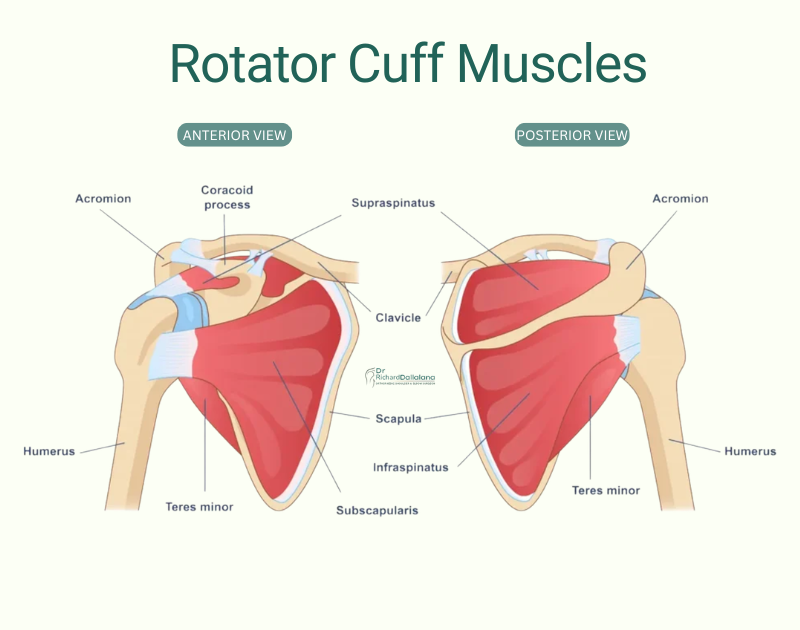
It is important to know that ‘rotator cuff tearing’ refers to fraying or tearing of the tendon part itself, not the muscle, and the tear occurs right at the point of connection of the tendon to the bone.
It is important to note that the majority of rotator cuff tears occur when a tendon, already weakened or partly torn from degeneration, is torn further by an incident or minor injury.
Rotator cuff tearing typically develops due to a combination of internal tendon damage and mechanical factors.
The older a person is, the more likely internal damage (degeneration) is occurring.
Internal Tendon Damage: As part of the natural ageing process, tendons gradually lose water content and elasticity. This reduces their ability to recover from repetitive micro-trauma associated with daily activities, work, or sport. Over time, cumulative damage weakens the tendon, particularly in the rotator cuff at the point where it connects to bone where blood flow is poor, making it more vulnerable to tearing, even with relatively low loads.
Mechanical Factors: This can be a sudden injury to the shoulder and can damage any of the 4 tendons.
The most commonly torn tendon, the supraspinatus tendon, can be also more slowly damaged due to pressure from a bone spur above it coupled with overuse.
The tendon passes through a relatively narrow space between the humeral head below and the acromion above it, where the spur grows. With repeated overhead movement or ongoing heavy physical strain, or in many people simply with the passage of years of normal living, the spur grows and enlarges putting pressure on the supraspinatus tendon below causing it to fray and eventually tear.
This process is progressive over years:
Spur formation and impingement → ‘tendinosis’ (weakening) of the tendon → ’partial tear’ → ‘full tear.
Bursitis is almost always present in people whose rotator cuff is deteriorating or torn, and is a consequence of the tear, the spur, or both. It is worse with higher activity levels and is a major cause of pain.
Not all rotator cuff tears require surgical treatment. Studies have shown that many people, particularly over the age of 60, have rotator cuff tears of different sizes without experiencing any symptoms. They are due to degeneration of the tendon and develop slowly.
If symptoms, examination findings, and imaging are consistent with rotator cuff disease, treatment directed towards the rotator cuff can be helpful. This can be with non-surgical strategies or operative repair.
Surgery may be recommended in anyone, of any age if medically fit, when symptoms persist after a period of appropriate non-operative treatment.
Surgery may also be recommended instead of non-operative treatment in cases of acute tears in active people causing weakness and limited movement.
Rotator cuff tears do not heal. If present they may increase in size. If very large, they may become impossible to repair and result in permanent pain, weakness and/or the development of arthritis. As such full thickness tears, particularly if large in size or involving multiple tendons, are on most occasions best repaired early before they increase in size.
Rotator cuff repair is most commonly performed using a minimally invasive arthroscopic technique. During surgery, the torn tendon is reattached to the bone using sutures and anchors. Additional associated problems or contributing to pain such as bone spurs, acromioclavicular (AC) joint arthritis, or biceps tendon pathology can be addressed at the same time.
Surgery is more likely to be needed in the younger the patient, the more sudden the tear, larger or full thickness tear size and the greater the weakness and limitation to movement. Non-operative treatment is preferred for the older age group, long-standing tears, partial or smaller sized tears and good movement range.
Message sent